Pearson Edexcel · GCSE · Business
Course version: 1BS0 · Version from Sept 2017
The purpose of business operations: ● to produce goods ● to provide…
Full specification wording
Business operations: The purpose of business operations: ● to produce goods ● to provide services.
Business operations refer to the core activities a business undertakes to transform inputs, such as raw materials and labour, into outputs that satisfy customer needs.
Checked against the Pearson Edexcel 1BS0 specification (opens in a new tab) on .
- Point 1 of 3
- 3 key terms
Study notes
From the checked teaching notes for this specification point.
The idea
Business operations refer to the core activities a business undertakes to transform inputs, such as raw materials and labour, into outputs that satisfy customer needs. The primary purpose of these operations is twofold: to produce tangible goods and to provide intangible services. Producing goods involves manufacturing physical items, like assembling smartphones or baking bread, requiring careful management of inventory and quality control. Providing services involves delivering non-physical actions, such as a haircut, financial advice, or a taxi ride, where the customer experience and staff interaction are paramount. Many modern businesses combine both, such as a restaurant producing a physical meal while providing the service of waiting staff.
What earns the marks
- Define business operations as the process of turning inputs into outputs to meet customer demands.
- Distinguish between the production of tangible goods and the provision of intangible services.
- Identify examples of businesses that primarily produce goods, such as car manufacturers or clothing factories.
- Identify examples of businesses that primarily provide services, such as banks, salons, or transport companies.
- Recognise that many businesses operate by offering a combination of both goods and services to add value.
Common mistakes and how to put them right
Failing to distinguish between goods and services.
Put it right: Clearly state that goods are tangible physical items, whereas services are intangible actions or experiences.
Assuming operations only apply to manufacturing businesses.
Put it right: Service-based businesses also have operations, such as managing staff rotas or booking systems.
Overlooking businesses that provide both.
Put it right: Acknowledge that many businesses, like restaurants or retail stores, produce goods and provide services simultaneously.
Exam tips
- Always read the case study carefully to identify whether the business primarily produces goods, provides services, or does both, as this affects their operational decisions.
- Use the terms 'tangible' and 'intangible' when distinguishing between goods and services to show precise business vocabulary.
- When asked about the purpose of operations, link the production of goods or provision of services directly to satisfying customer needs and adding value.
Try the lesson
The start of the Business operations: The purpose of business operations: ● to produce goods ● to provide services. lesson, made from checked teaching notes for this specification point.
Have a go first
Which of the following is an example of a business operation whose primary purpose is to produce goods?
Listen
Business operations refer to the core activities a business undertakes to transform inputs, such as raw materials and labour, into outputs that satisfy customer needs. The primary purpose of these operations is twofold: to produce tangible goods and to provide intangible services. Producing goods involves manufacturing physical items, like assembling smartphones or baking bread, requiring careful management of inventory and quality control. Providing services involves delivering non-physical actions, such as a haircut, financial advice, or a taxi ride, where the customer experience and staff interaction are paramount. Many modern businesses combine both, such as a restaurant producing a physical meal while providing the service of waiting staff. A strong answer earns marks for these points. Define business operations as the process of turning inputs into outputs to meet customer demands. Distinguish between the production of tangible goods and the provision of intangible services. Identify examples of businesses that primarily produce goods, such as car manufacturers or clothing factories. Identify examples of businesses that primarily provide services, such as banks, salons, or transport companies. A common slip: Failing to distinguish between goods and services. Instead, clearly state that goods are tangible physical items, whereas services are intangible actions or experiences. Exam tip: Always read the case study carefully to identify whether the business primarily produces goods, provides services, or does both, as this affects their operational decisions.
See it

Key words
Say what each word means before you turn the card.
Business operations
Try answering aloud or in your head before turning the card.
Goods
Try answering aloud or in your head before turning the card.
Services
Try answering aloud or in your head before turning the card.
See every definition
- Business operations
- The core activities a business undertakes to transform inputs, such as raw materials and labour, into outputs that satisfy customer needs.
- Goods
- Tangible physical items that are produced, such as smartphones or bread.
- Services
- Intangible actions or experiences that are provided, such as a haircut, financial advice, or a taxi ride.
Label the diagram
Some boxes have lost their names. Pick the right name for each number.
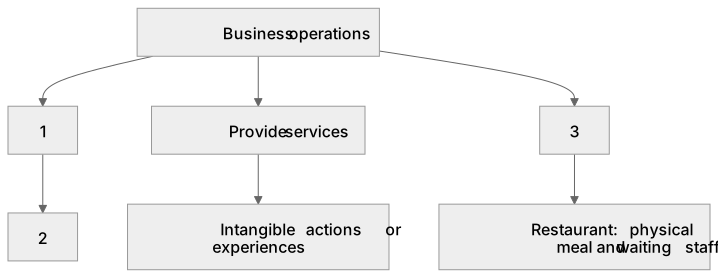
1Box 1
2Box 2
3Box 3
There is more to this lesson
The full lesson goes on to check your understanding and help you earn the marks. Create a free account to carry on, with your progress saved.
A week of Premium from your first lesson · Then the free plan continues · No card, no charge
Test your understanding of Business operations: The purpose of business operations: ● to produce goods ● to provide services.
Active recall beats re-reading. Take an instant quiz now to test what you’ve learned and lock it into long-term memory.
A week of Premium from your first lesson · Then the free plan continues · No card, no charge